2026 Yellowstone Area Streamflow and Fishing Predictions
Posted on February 22nd, 2026 in Season Forecasts, Weather & Water Conditions
Introduction
Winter snowpack and how this snowpack melts from April through mid-June are the most important factors in determining summer water levels and fishing conditions. They’re also important factors in “quality of life” aspects of summer fishing, such as how much wildfire smoke can be expected in late summer.
This is our post about snowpack and expected conditions for the 2026 season. This post will be updated every couple of weeks as conditions change, until roughly June 5 to June 15, when we expect all area fisheries to be finished with the spring melt and ready to go for the summer season. The most recent revision date is given below.
Updated on March 22, 2026
There are substantial changes in this update due to the recent spell of record heat as well as a forecast calling for more above-normal temperatures.
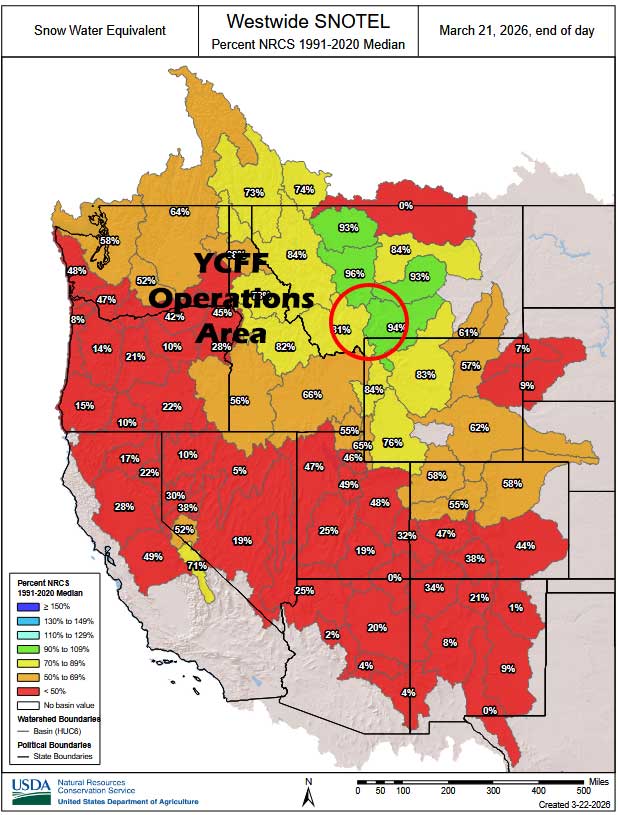
Westwide snowpack as of March 21, with YCFF operations area circled.
The Extremely Short Version
This winter has seen record-warm temperatures and a slightly below normal overall snowpack, culminating in the recent record heat wave that saw temperatures more typical of June than March. Some weather stations in our operations area set record daily highs by more than ten degrees Fahrenheit. We anticipate substantial impacts to late summer fishing opportunities. If summer sees extended extreme heat and drought, fishing opportunities and our ability to operate in August may be very limited. Any of our competitors (as well as guiding operations elsewhere in the West) who say otherwise are lying to you and do not deserve your business.
What do we mean by the last statement above? Low, warm water is now certain beginning in early July. This means that widespread 2:00PM and many complete fishing closures are almost certain, with the most widespread closures in place between July 20 and the end of August. We would be surprised if all major fisheries do not have 2:00 closures in place between July 20 and the end of August, and universal 2:00 closures on all flowing waters except tiny mountain creeks seem likely. Record-low daily flows are likely beginning in late June.
The best summer fishing conditions are likely to be found from roughly June 10 through July 10, weeks ahead of schedule. We suggest coming MUCH earlier than you would during a “normal” year, if possible.
The overall precipitation and even snowpack numbers aren’t the problems. The problems are the fact that this snow was very warm and thus prone to melting, plus the fact it has all started melting six weeks early, when we should still be building snowpack. The sponge is simply going to be dry by the time the weather gets hot, and low water means warm water. Historically, July through early September has been peak season in our operations area. This year it will be June and early July.
The whole West outside of our operations area is actually in even worse shape, so wildfire smoke from distant fires is likely to be present and may be intense (actually good for the fishing, not for the views or the breathing). Local fires may also be bad, though this depends on lightning rather than just dryness.
It is now too late in the winter to fundamentally change the above. Cool, wet weather (that isn’t forecast) through mid-June would make a huge difference on preventing extensive closures, but low water and an early start to the summer season now seem certain.
Current Conditions
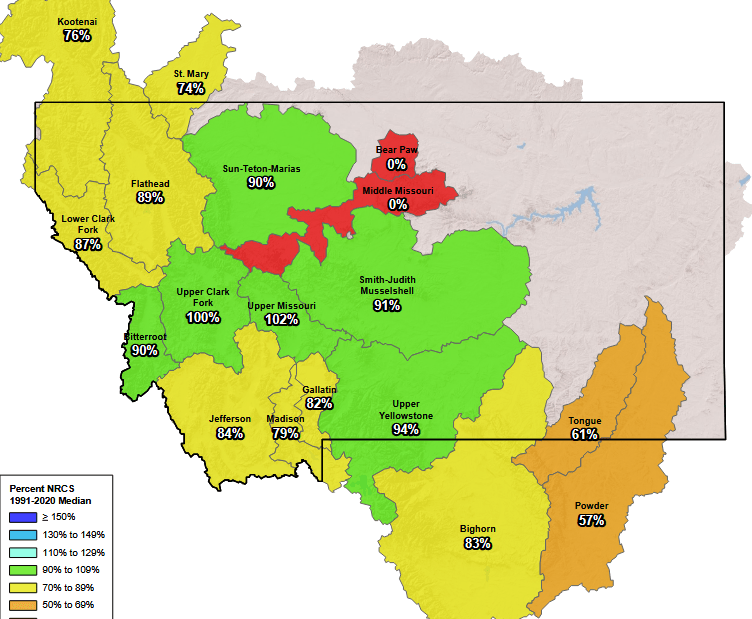
Detailed Montana snowpack numbers by basin as of March 21, 2026.
- Fall generally saw normal temperatures and a lot of moisture (both rain and snow). December saw extremely high moisture, but very high snow levels due to warm temperature. January and early February saw record warmth and dryness. The middle and beginning of the latter part of February were near-normal for both temperature and precip. Late February and early March were warm and saw near-normal precip. Mid-late March have seen record heat and no precip.
- Snowpack in the Yellowstone River basin is below normal, at 94% of normal, but it is higher than almost all “trouty” river basins in the West. Some portions of the Clark’s Fork and Upper Missouri Systems have higher snowpack for the moment, but this is due to a giant storm that hit them and missed us in mid-March. The snow from this storm is melting off very quickly, actually leading to localized flooding, so it won’t help much for summer.
- Snowpack in the Madison and Gallatin basins is below normal, but still higher than most basins in the West.
- Precipitation during the 2026 water year (which starts Nov 1) has been good, at at least 103% of normal throughout our operations area.
- Regardless of location, the snowpack is limited to high elevations. High-elevation snow sensors report above normal snow depth and water content, while areas under 8000 feet have essentially melted out already.
- It seems likely that even high-elevation snowpack has peaked and runoff has begun, six weeks early for both.
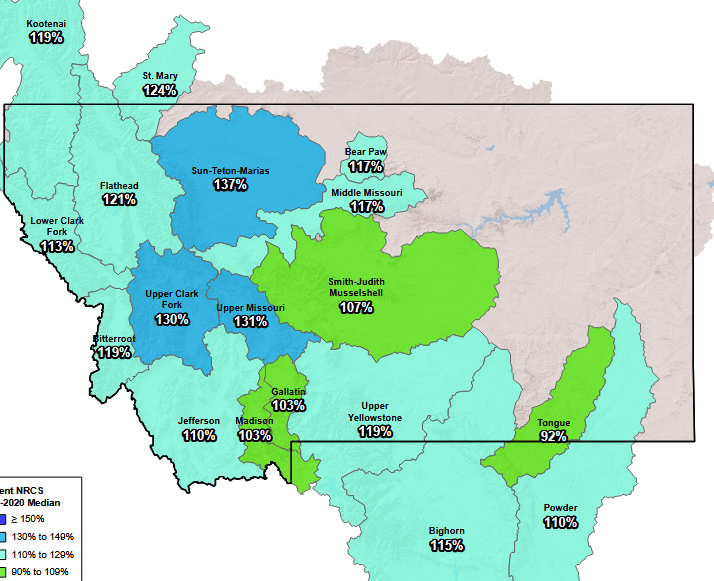
Montana water year precipitation numbers as of March 21. These numbers are actually decent, but include rainfall that doesn’t help late summer streamflow as much as a heavy snowpack that melts slowly.
Outlooks for Late Winter and Spring
Here are some bullet points about outlooks for the remainder of winter (winter normally lasts through April at high elevations) and spring (April through mid-June). These outlooks come from the National Weather Service Climate Prediction Center.
- The 6-10 day outlook is calling for continued extreme heat which somewhat moderates in the 8-14 day. Rain may occur in the 8-14 day. With above-normal temps, it seems likely that additional snowfall will be limited to extremely high elevations.
- The 3-4 week and monthly outlooks call for above normal temps and below normal precip.
- The three-month rolling outlook for April through June is calling for above normal temperatures and below normal precip, exactly what we don’t need.
- Later in spring and in summer, an El Nino is forecast to form. This leads to increased likelihood of above normal temperatures and below normal precip for the entire Rocky Mountain West and Pacific Northwest until fall.
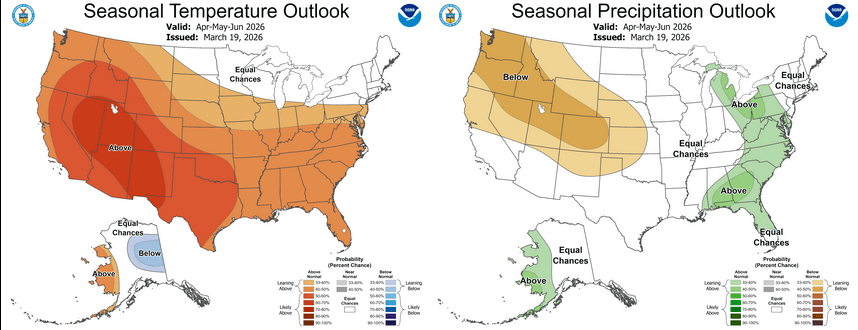
April through June seasonal climate outlook
What Does the Above Mean, Generally Speaking?
This is the important part for most readers. This is what the above is likely to mean for fishing conditions during our runoff season and most of peak season, roughly April 20 through sometime in September (hopefully early-mid September), after which day-to-day weather such as the onset of fall rains and mountain snows is a bigger factor than weather from the previous winter/spring.
- The low elevation snowmelt is already complete. Mid-elevation snowmelt is well underway (which is why the local ski areas are closing weeks ahead of schedule). High-elevation snowmelt has begun.
- We no longer anticipate a heavy spring runoff. It started too early. Basically, we now expect muddy water when temperatures are warm and “green is good” water when it cools down for a few days. It now seems unlikely that anywhere in our operations area will be out of the question for weeks at a time as in a normal year, except maybe for the Lamar River System.
- The melt will end early. The precise dates depend on the watershed, but it now seems likely that all fisheries will stop being muddy even during hot weather no later than June 10-15 or so, and many much sooner. Instead of snowmelt, the governing factor for clarity in late May and June most places will be spring rainfall.
- This will lead to many more options in May and June than we usually see.
- On the other hand, it will lead to low, warm water everywhere between July 4 and the onset of the fall rains in September, and this warm water may even start earlier on some low-elevation watersheds, especially those with a lot of irrigation drawdowns and/or hot spring inputs.
- Widespread 2:00 are basically certain in late summer. The timing of these closures will depend on when prolonged hot weather hits. Most or all major fisheries are likely to be impacted by them. The Firehole, Gibbon, and Madison Rivers in Yellowstone Park and the lower Madison River near Bozeman will see the earliest closures (perhaps as early as June 10 for the YNP waters). The Yellowstone River, upper Gallatin River near Big Sky, upper Madison River and small streams in MT will hold on the longest into late summer, with the small streams in MT the least likely fisheries to see any PM closures. We now expect 2:00 closures on all major fisheries by July 20.
- Complete fishing closures are likely on the Lower Madison, Jefferson, Madison Basin in YNP (the geyser-heated water), and several smaller rivers at the fringes of our operations area like the Smith and Dearborn. They are possible on the Yellowstone River, especially east of Livingston.
- Extreme fire restrictions are almost certainly going to be required by early July: no smoking unless you’re on pavement or in a river, no campfires or grilling, obviously no fireworks, etc.
- If we see a lot of fires, it is possible we’ll see complete closures of all outdoor recreation in late August and September. This IS NOT likely. The only time it has ever happened was during the chaotic 1988 fires. But it could be on the table if the summer weather and fire conditions are exactly what we don’t want.
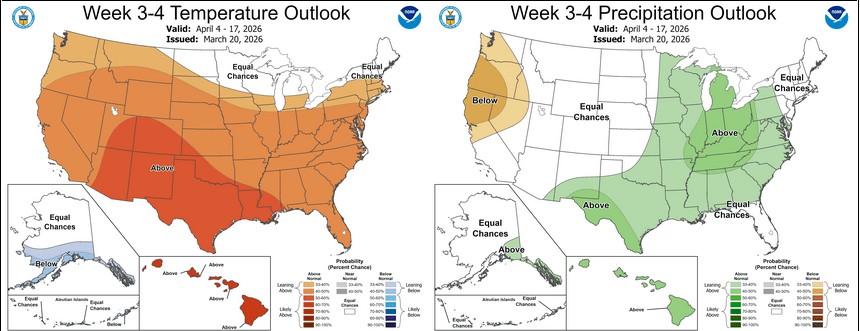
Long range weather outlooks do not offer much hope for any addition to our remaining snowpack, and suggest the early melt will largely continue.
When Will Runoff Begin and End? When Will Waters Get Too Warm?
Specific rivers, river systems, or sections of rivers are listed in order of “end of runoff,” earliest to latest, more or less. “Classes” of waters such as small streams are discussed at the end of the following list.
- Firehole, Gibbon, and Madison in YNP: These waters open May 1 this year, for the first time ever. Runoff will likely be over already, or so close to over as to make no difference since it’s usually pretty minor on these waters anyway. Typical late May and early June hatches will already be underway and possibly transitioning into the summer White Miller caddis. These water will get too warm to fish during any multi-day warm, sunny spells, even in May, though cool, rainy days will remain good until maybe June 10. After that, expect complete closures on the “name” sections of all these rivers to last into September beginning with the first sustained run of 80+ weather. The Gibbon upstream from Norris Geyser Basin is a small creek without hot spring inputs, so it will be fine through June and into July, will avoid full closures unless YNP closes everything, and will avoid 2:00 closures unless they are instituted on all waters.
- Lower Madison River: The Madison from Ennis Dam to Three Forks will not see an unfishable runoff, just some murky water below Cherry Creek here and there. The best fishing will occur in May. Heavy crowds of kayakers and tubers will start impinging no later than June 10, and the first really warm weather after this will cause the water become too warm to fish well/ethically until mid-September. 2:00 or complete closures will likely begin July 1 and continue until early September.
- Upper Madison River: The upper Madison will not experience an unfishable runoff, just a few days here and there when it is murky. Expect the water to drop enough to fish dry flies around the beginning of June. Full closures are unlikely, but we now anticipate 2:00 closures between July 20 and Labor Day, especially in the “braids” section between the bridge in Ennis and Ennis Lake. You might need roller skates on the bottom of your drift boat to float this water in August and early September.
- Boulder River: Unfishable runoff will be limited to hot days here and there in late April and early May. Flows are likely to drop into fishable shape for good between May 15 and the end of May, with the best fishing during this period and early June. Flows will get too low to float no later than the end of June. Closures are unlikely, but from an ethics standpoint they should be put in place when the water is super skinny in late July and August. The upper river will fish fine all summer, since it’s basically a creek.
- Stillwater River: Push everything I said about the Boulder back by about a week. 2:00 closures are likely below Nye (the floatable portion) between July 20 and Labor Day, and flows will probably get too low to float around August 1-10.
- Gardner River: Reminder that this one is open year-round now. Will see a day of muddy water here and there but no extended unfishable runoff. These windows of dirty snowmelt will end around June 1-5. The best fishing below Boiling River will occur in the first half of June. Above Boiling River, it will be June 15 through July 15. The water is likely to get too warm to fish ethically below Boiling River during the first spell of 90-degree weather in late June or early July and remain too warm until mid-September (and very low and weedy thereafter). 2:00 closures are likely below Osprey Falls starting around July 20, even though the water between Osprey and Boiling River usually stays cold enough to fish ethically. The upper Gardner near Indian Creek Campground will fish best June 15 through July 15 and is unlikely to see closures unless all park waters get them.
- Yellowstone River – Grand Canyon: This one is the big question mark. The headwaters of the Yellowstone River still have enough snow that this one might not get too low to fish well, since Yellowstone Lake will collect all this water and let it ease out. If Yellowstone Lake were a reservoir with a dam rather than a natural lake, we’d be A LOT less worried about having enough water in late summer. Even being natural, the lake moderates things a bit. We still expect everything to happen very early here, and for there not to be any completely unfishable runoff once the river opens on the Saturday before Memorial Day, but the water may be high and sort of a gray color until June 15. The best fishing will be from mid-June until mid-July, but this stretch will hold on better in late July and August than any other major fishery in our operations area. Full closures are unlikely. 2:00 closures are only likely if almost everything in YNP gets them.
- Yellowstone River – Black Canyon: The Black Canyon (from the Lamar confluence to the park entrance at Gardiner) will be in runoff on the park opener and is one of the most likely places to be too dirty to fish at all for more than a few days at a time. This “maybe” runoff will conclude in the first week of June. The best fishing will be from June 10-15 until early July and will remain good until late July as long as extreme heat doesn’t start early. This water runs warmer than the Grand Canyon, but 2:00 closures are also less likely here than many other places. If they come in, it will be after July 20.
- Yellowstone River – Montana: Runoff is already underway, though the river will clear again whenever daytime highs are in the 50s rather than the 60s or higher. The river is likely to clear for good around the beginning of June. The fishing will be great with nymphs whenever this happens, but the peak dry fly fishing will occur after temperatures warm consistently into the 70s in mid June and remain good until consistent 90s start. 2:00 closures are likely after July 20, and full closures are possible. All closures will start earlier and last longer east of Livingston where the water is warmest and there aren’t any cold tributaries.
- Lamar River System in YNP: This is the other area that might see any kind of extended “real” runoff. This is most likely on the Lamar and Soda Butte Creek. I expect Slough Creek to be marginally fishable (with streamers, etc.) when this water opens the Saturday of Memorial Day Weekend. The “sometimes muddy” period will end June 10-15 at the latest, and maybe a week earlier. The best fishing will be from mid-June through mid-July. 2:00 closures are likely July 20 through Labor Day. Even after this water reopens, it will be extremely low and in our opinion Soda Butte Creek should be completely closed since it will be nothing more than a trickle.
- Yellowstone River – Lake to Falls and Headwaters: This water opens for the season on July 1 and will fish great for a couple weeks. The population here is highly migratory, with most fishing living in Yellowstone Lake and only spawning and then hanging out in the river for a few weeks after spawning. With how early everything is happening, they may already be heading back to the lake in droves by July 1, so I expect fishing to start tapering off in late July even though this usually occurs in August. 2:00 closures are less likely here than on any other river in our core operations area, since this water is at high elevation and is coming from huge, cold Yellowstone Lake.
- Other Rivers in the Region: The Gallatin River upstream from Gallatin Gateway will come into shape sometime in the first week of June. It will be fine temperature-wise all summer, but probably very low and weedy from early July onward. It’s always crowded. Downstream of Gateway and particularly downstream of Four Corners, irrigation drawdowns will prompt 2:00 closures by mid-July (and maybe earlier) and probably full closures in August. The Jefferson River is already in runoff. It will likely clear for good in mid-late May. It will get too warm to fish during the first warmup in late June, with 24-hour closures almost certain shortly thereafter. To be honest, it amazes us that any trout still survive in this river given how much irrigation water is taken from it. 75+ degree water is common here. The Lower Beaverhead and Big Hole Rivers will see extreme low water by mid-July and full 24-hour closures are likely from late July until late September, particularly on the Big Hole. The Missouri River below Hauser & Holter dams (the tailwater “trouty” stretches) will be low and weedy all season, but will avoid 2:00PM closures unless we see extended extreme heat. Word is they fished absolutely awful from August through mid-October in 2025 due to low water and extreme weed growth. We’d expect the same this year, but at least the water will probably be cool enough…
- Small Streams: Low-elevation small streams like the East Gallatin will finish their limited runoff by early May. There just isn’t enough snow in their basins. They will get some combination of too low and too warm by mid-June. Higher-elevation but gentle creeks such as those on the Central Plateau in Yellowstone Park will get warm enough to fish around the beginning of June and fish best for a month thereafter. Closures are unlikely on anything in YNP unless all flowing water gets them, but by late July some of these creeks will have less water in them than what runs down your gutter when you’re washing your car. The rough and tumble mountain streams will come into shape in the middle of June, roughly, with level rather than clarity the governing factor. July will offer the best fishing on most. Closures are unlikely on any of these in Montana. In YNP, those feeding the Firehole/Madison/Gibbon and lower Gardner will share the closures their parent rivers get. Others will only see 2:00 closures if all flowing water in the park gets them.
- Spring Creeks: The Paradise Valley Spring Creeks are protected from the worst impacts of low (or high) water since they are spring-fed. The best periods as always are late March through about April 25, June 20 through July 20, and late fall. The June 20 through July 20 period is booked solid already and won’t have wide availability even in 2027, since this is always peak season. Closures won’t happen unless there’s widespread fire or something of that nature that shuts down all outdoor recreation (this only happened in 1988).
- Ranch Lakes: The ice is off already. The best fishing will occur between April 15 and early June. They will get too warm to fish well/ethically whenever the first truly hot spell hits, possibly by early June.
- Low Elevation Public Reservoirs: All are ice-free. Fish the windswept shorelines between now and early May, then leave these to the walleye and perch anglers, because the trout will go deep by early June at the latest.
- High-Elevation Lakes, Including the Beartooth: Those in YNP will be ice-free by the opener in late May, and it now also seems likely the worst of “mud season” will also be past. The best fishing on these will be on warmer days from the opener until June 10, during normal weather for the remainder of June, and on cloudy/cool days in July. Late summer is unlikely to see closures, but will probably see tough fishing as the fish go deep to beat the heat. On the Beartooth, expect most lakes to be ice-free and accessible by early June. The best fishing will occur in late June and early July. August might see some tough fishing even at these above-treeline lakes if summer comes early and the waters warm enough to send the trout deep.
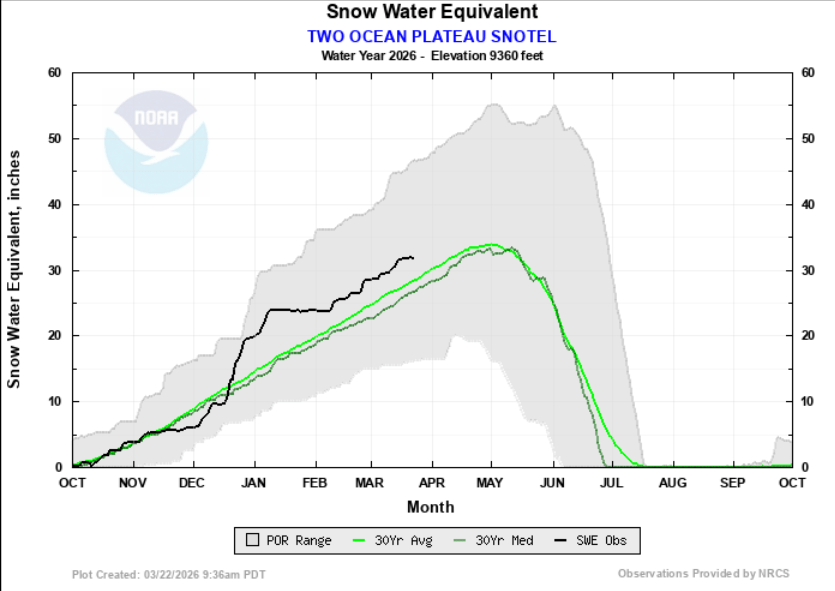
Snowpack at Two Ocean Plateau Snotel (high elevation) as of March 22. While still above average for the date, and near the mean and median annual peaks, it seems our peak snowpack even at high elevations has been reached more than a month early.
Other Key Dates
This is sort of a grab bag for when we expect various season highlights to occur, based on expected water conditions. They are in no particular order.
- Firehole River Caddis: May 1 through early June.
- Yellowstone River Mother’s Day Caddis: Probably washed out by runoff. If not, the latter half of April.
- Lower Madison Mother’s Day Caddis: May 1 through May 20. Flows should permit good dry fly fishing this year, so long as it isn’t too hot and bright.
- Yellowstone River Salmonflies (Montana): Expect a very fishable but very fast-moving hatch this year. It will be begin during the first sustained warm spell around June 10, maybe even a few days earlier.
- Yellowstone River Salmonflies (YNP): A few may pop near the small hot springs around Tower Falls around June 10, but June 20 for the Lower Black Canyon and June 25 to July 4 elsewhere will be heavier.
- Lamar System Green Drakes: The full-size #10-12 Drakes (Drunella doddsi) will probably start around June 15. June 20 through July 4 will be best. The smaller #14 Drakes (D. flavilinea or D. coloradensis) will shade in around July 1 and dominate into September. A few of the doddsi return in mid-September, but Hecuba and a few D. grandis are more common then.
- Yellowstone River “Chubby Rubby” Fishing: This big dry and big nymph bite will be best in late June.
- Yellowstone River Hoppers & Ants: This bite will start very early, probably by July 10 and maybe even July 1. July will be best for hoppers, especially larger ones. Good hopper fishing now seems unlikely in August and September except on gray days; the water is just going to be too low and the fish too spooky.
- Boulder River Float-Fishing: The Boulder always has a short window. May 25 through July 1 seems likely this year.
- Yankee Jim Canyon Floats: I don’t do Yankee Jim with clients until flows are under 5000cfs. 4000cfs is better. 3000cfs is probably optimum, with fishing gradually getting slightly harder once things get below 2500, but the canyon remains good no matter how low it gets as long as water temps are okay. Expect 5K around June 15, 4X June 25, and 3K July 4.
- 4th of July Crowds? Sometimes the 4th of July holiday and weekend aren’t too crowded. This year crowds will likely be awful since flows will allow fairly easy floating and wading and the 4th itself falls on a Saturday. I’m going to do my best not to run float trips on the 4th and 5th this year, and my trips on the 3rd will start and end early. The Lower Madison will be a JOKE SHOW.
- Most Likely Period for Widespread Fishing Disruptions Due to Heat & Low Water: July 20 through August, though challenging fishing in terms of techniques, crowds, and spookiness of the trout will continue until the fall rains hit in mid-late September.
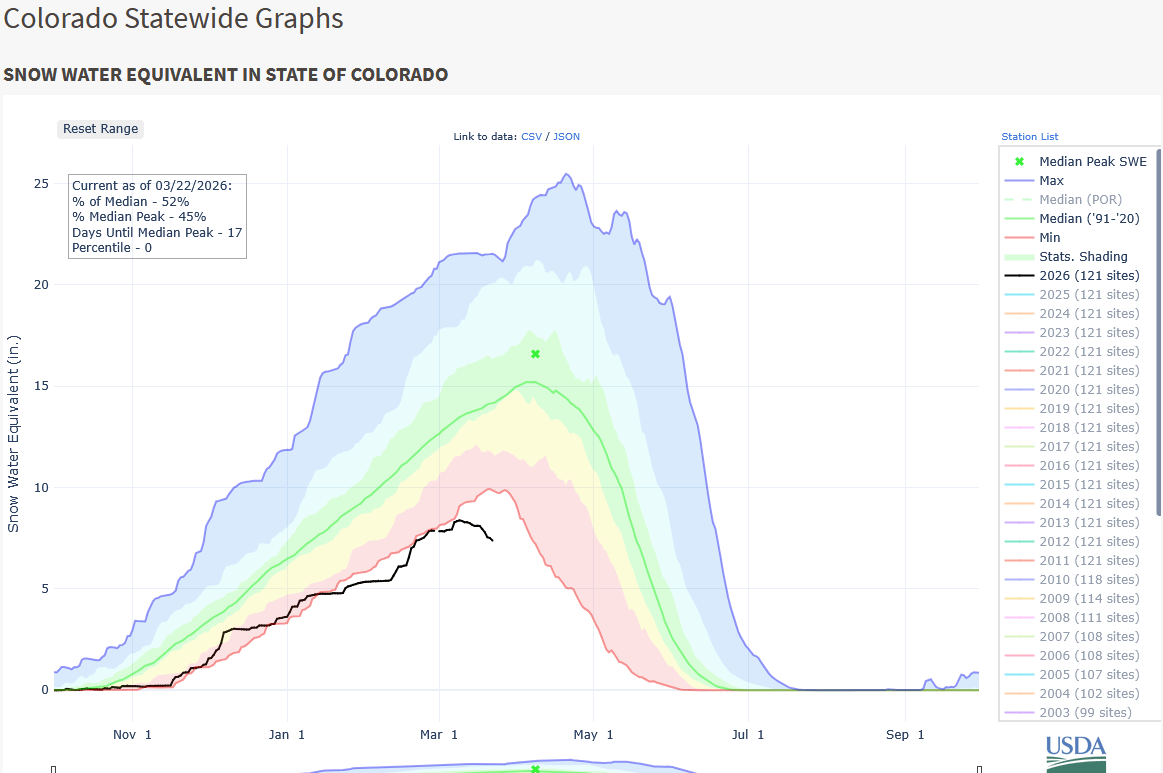
Feeling for folks in CO this year for sure. We at least have an almost-normal snowpack to burn through. They are in the same boat as us in terms of an early melt, but from a lower starting point.