Snowpack Update for Feb 22 2023
Posted on February 22nd, 2023 in Newsletters, Season Forecasts, Weather & Water Conditions
After a wet past week and bitter cold weather (below zero in Livingston, probably -20 in YNP) snowpack has risen back to over 100% of normal for the date. This is great news. We had been trending steadily downward for the past 6–8 weeks in comparison to normal after a very cold and wet autumn.
We like snowpack to run 100–110% in our main basins (Yellowstone River in Montana and YNP, currently 102% and 104% of normal on the graphic) as of mid-May. This ensures enough water to keep the Yellowstone and its main tributaries like the Lamar, Gardner, Boulder, and Stillwater running high and cold all summer, which keeps the trout happy, but also for them to drop into fishable level and clarity at the normal time in the last week of June or first week of July, which keeps fishermen and guides happy. As of right now, we’re right on track for good conditions this summer.
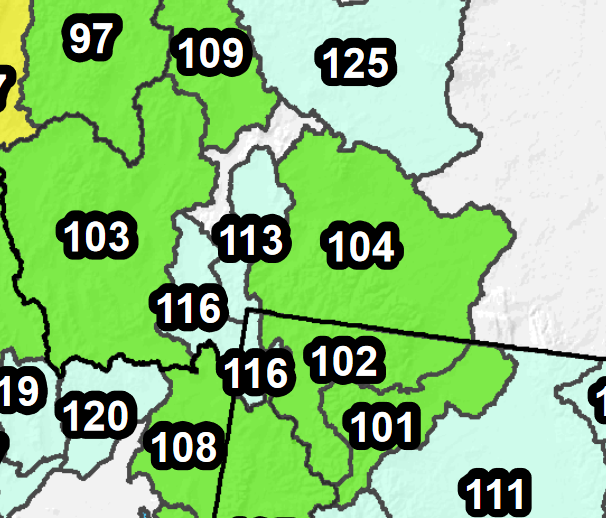
Northwest Wyoming and south-central Montana snowpack numbers for February 22, 2023.
A couple of positive oddities in this map are worth noting.
First off is that the Yellowstone outside YNP is showing higher snowpack than inside the park. Again, 104%. This number actually factors in the snowpack in the upper Yellowstone Basin too, since it all flows downhill. All things considered, the mountains feeding the creeks between Gardiner and Livingston, plus the Shields, Boulder, and Stillwater Basins further east, actually have stronger snowpack than Yellowstone does. Since these basins all suffer from irrigation drawdowns and thus struggle to stay cold all summer, this solid snowpack could really help keep water temps on the Yellowstone east of Livingston cold all summer (no early-out at 2:00PM) and also keep the Boulder and Stillwater floatable will full-size rafts until later in the season. Both these rivers are floatable an extra month in our new ultralight raft (photo courtesy Smithfly) anyway, but the big raft is more roomy and comfortable.
The second oddity is even more exciting. The Madison-Gallatin basin in YNP is at 116% of normal. Usually this basin lags behind the basins further north, primarily because the mountains at the headwaters of the Madison basin in YNP feeding the Firehole and Gibbon Rivers are lower elevation than the ranges elsewhere, meaning the snow tends to skip overhead. The West Yellowstone SNOTEL sensor at relatively low elevation reports a whopping 131% of normal snowpack.
What’s all this mean for the Madison, Firehole, Gibbon, and Gallatin? Well, for right now it means nothing. A big warmup in May and June could melt all that snow in a hurry. That said, if current trends continue, the Firehole, Madison, and Gibbon will have much more cold water entering the system than usual, until later in the summer. Since warm water is the problem in these basins after about June 20, this could lead to a longer late spring fishing season on the Firehole, Gibbon, and Madison in YNP, possibly well into July when we’re usually done fishing this area until late September around June 20–25. Great news for Firehole fans!
If the above numbers hold, we could actually have a fishable Yellowstone, Boulder, and Gardner River at the same time we still have a fishable Firehole and Gibbon. Usually there’s a shaky week in late June or the first week of July when none of the above are prime, and I honestly can’t remember a year when both drainages are prime. Let’s hope this year is the outlier!
Our next snowpack update will drop sometime in the first half of March, especially if a big warmup or a giant storm substantially changes the above numbers. In the meantime, follow the westwide snowpack numbers at this link, which is updated daily. The drainages important to our operations are all near the junction of Wyoming and Montana.
Brief Update on Late-Summer Conditions and Guided Trip Availability
Posted on March 30th, 2022 in Season Forecasts, Weather & Water Conditions
Our next full update on snowpack and current summer water conditions should drop on Friday. That said, recent continued degradation to our already scant snowpack means that we are now certain to experience extreme drought conditions in late summer. Record low flows and the worst late-summer fishing conditions since 1988 are now likely.
As such, we now actively DISCOURAGE potential clients from planning fishing trips to Montana from August 1 through August 20. We are likely to face broad and extreme fishing restrictions to protect trout at this time, possibly including full fishing closures in Yellowstone Park and on most or all large rivers outside it. 2:00 closures on all major trout waters are now almost certain.
For clients who are planning general family vacations and still want to get a day of guided fishing in, we will accept August bookings only on a “guide’s choice” basis as far as trip type, duration, and target species. We heartily encourage arranging “peak season” travel to fish in June and the first three weeks of July or after September 15.
Early February Snowpack Report – Do Your Snow Dances
Posted on February 2nd, 2022 in Area Fishing News, Season Forecasts, Weather & Water Conditions
I won’t bury the lede. We have had a warm, dry winter in Montana. Coming on the heels of record heat and drought last summer and a warm, dry winter in 2020-2021, we desperately need snow.
As of right now, the numbers don’t look too bad. I’ll let the following map do the talking. Our operations area is outlined in red: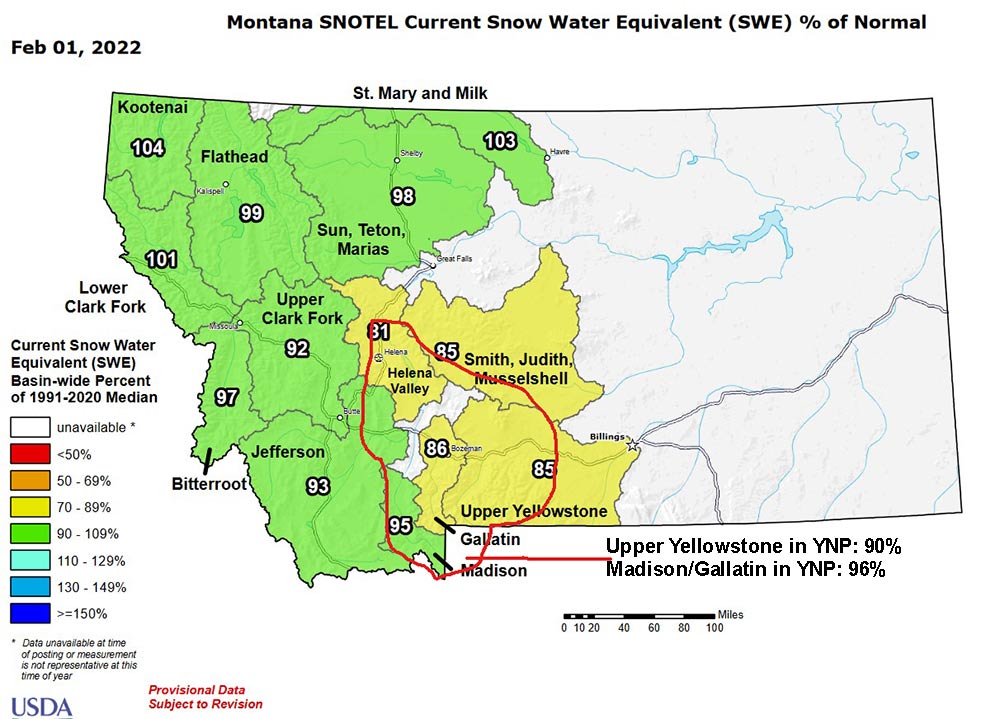
The problem is that these numbers are showing across the board declines over the past month. While the east has been getting pummeled by storm after storm, we have been in a horrific dry spell. The above are percentages of normal for the date, meaning that here in Livingston we’re at 85% of normal accumulated snowpack for this time of year, since we’re in the Upper Yellowstone basin. In early January, we were 15 points higher. The Madison/Gallatin basin in YNP was more like 30 points higher. The basic problem is that January is historically one of our three snowiest months, along with March and April. For all intents and purposes, it has not snowed at all in the past month.
Long-range outlooks through February 10 or so suggest continued warm and dry conditions. After February 10, a possible shift to cold/wet conditions is possible. We want this shift. In general, we prefer normal to slightly high snowpack to keep our waters running cold through the summer. To have any hope of getting such conditions for summer, we really need to shift during February rather than later, since we have such a debt to make up after last year. All of Montana and western Wyoming is in severe, extreme, or exceptional drought, the three worst categories. Without substantial improvement to snowpack, our drought situation and therefore summer/fall streamflows will not improve.
It is still early enough we can’t make set-in-stone predictions about summer streamflows and fishing conditions. Our first in-depth predictions will come around March 1. Even so, the following conditions seem likely given our drought situation and current snowpack numbers:
- We anticipate an early end to the spring snowmelt and low flows overall. Even if snowpack improves to near-normal, this still seems likely.
- Water conditions will be better from sometime in the latter half of June through July than they are in August and early September. Precise dates will depend on how much snowpack changes (hopefully improves) and when this snow melts.
- Low, warm water is likely. Poor fishing conditions on some low-elevation waters are basically certain, and at least some 2:00PM fishing closures are probable. Last summer such closures were universal between late July and late August. Without substantial improvement, we are headed for similar closures in 2022.
We will put up another update in mid-February, hopefully with an improvement in snowpack or at least better prospects for snow to report.