Summer Streamflow & Fishing Forecast for Mid-March, 2024
Posted on March 13th, 2024
Winter 2023-2024 has been warm and dry in Yellowstone Country, just like it has just about everywhere except California through Colorado. For a while we were flirting with record-low snowpack, and 50 degree days have been more common than below-zero here in Livingston. At the end of January we were expecting dire summer water (and fire) conditions. While February and early March have generally been wet, and not as warm relative to average, we still anticipate a light runoff that ends early, followed by low water and difficult conditions in late summer. Cross your fingers for a late runoff and wet spring and early summer.
Note that the maps we used to include on these posts are no longer produced. Instead, find them here: NWCC Maps.
Season Forecast & Runoff Update for May 3, 2023
Posted on May 4th, 2023
Just a quick update as I’m busy with trips (heading up to the MO for a few days, since we’re muddy near Livingston) and NOAA has not updated snowpack totals lately.
Spring (summer?) hit with a bang this past week. We had not had more than 1-2 days over 70 degrees all spring, and most were in the 40s-50s. That changed a week ago. We have been in the 70s and maybe pushing 80 today. This has pushed all area waters into runoff. Even the Lower Madison is “meh.” Very slow fishing the past few days, anyway, with murky water, no risers, and some detritus in the river.
This MAY push likely summer “fishable dates” a week earlier, though there is still A LOT of low snow. As of yesterday (May 2), there was still snow cornices on NE-facing hilltops adjacent to the highway in Livingston, at less than 4600 feet above sea level. High-elevation snowpack has barely budged yet. Moreover, we’re looking at a cool spell next week. Temps in Livingston are supposed to drop from this week’s absurd highs (windows in the house open all night) to highs in the 50s by Saturday.
The cool spell is going to mean money fishing on the Yellowstone and probably the Boulder and Stillwater Rivers, with Mother’s Day Caddis out and about, probably from Weds next week through at least the following Sunday (the Sunday in question being Mother’s Day). Flows are forecast to drop from 6000+ cubic feet per second to a bit over 3000. BIG improvement, and almost certain to fish well. Even if there aren’t any caddis, these runoff breaks almost always turn out lots of big fish on streamers.
Long story short: runoff now, a break in a week, and maybe a SLIGHTLY earlier end to the runoff in late June and early July, compared to our most recent report.
Missouri River fishing report this weekend!
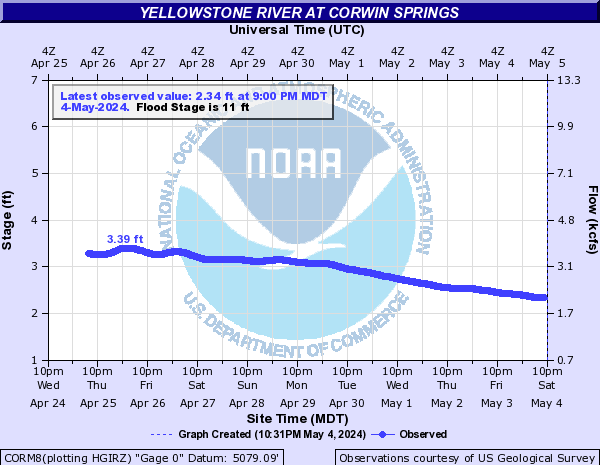
Predicted Yellowstone River flows for the next ten days. That “flatline” is going to be a sweet spot for great fishing before the next peak of runoff hits following the next warmup.
Snowpack Update for Feb 22 2023
Posted on February 22nd, 2023
After a wet past week and bitter cold weather (below zero in Livingston, probably -20 in YNP) snowpack has risen back to over 100% of normal for the date. This is great news. We had been trending steadily downward for the past 6–8 weeks in comparison to normal after a very cold and wet autumn.
We like snowpack to run 100–110% in our main basins (Yellowstone River in Montana and YNP, currently 102% and 104% of normal on the graphic) as of mid-May. This ensures enough water to keep the Yellowstone and its main tributaries like the Lamar, Gardner, Boulder, and Stillwater running high and cold all summer, which keeps the trout happy, but also for them to drop into fishable level and clarity at the normal time in the last week of June or first week of July, which keeps fishermen and guides happy. As of right now, we’re right on track for good conditions this summer.
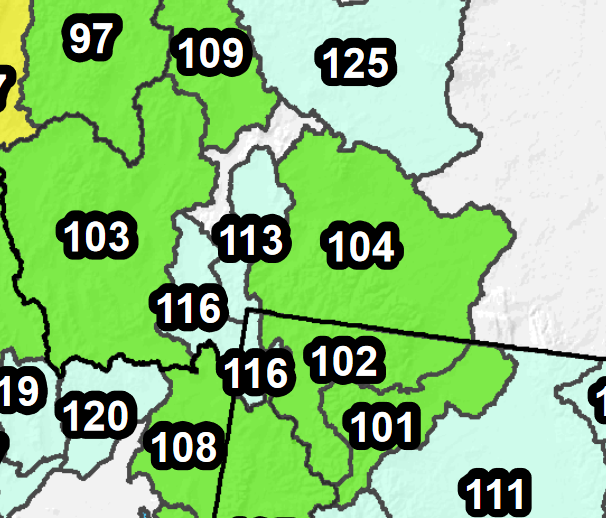
Northwest Wyoming and south-central Montana snowpack numbers for February 22, 2023.
A couple of positive oddities in this map are worth noting.
First off is that the Yellowstone outside YNP is showing higher snowpack than inside the park. Again, 104%. This number actually factors in the snowpack in the upper Yellowstone Basin too, since it all flows downhill. All things considered, the mountains feeding the creeks between Gardiner and Livingston, plus the Shields, Boulder, and Stillwater Basins further east, actually have stronger snowpack than Yellowstone does. Since these basins all suffer from irrigation drawdowns and thus struggle to stay cold all summer, this solid snowpack could really help keep water temps on the Yellowstone east of Livingston cold all summer (no early-out at 2:00PM) and also keep the Boulder and Stillwater floatable will full-size rafts until later in the season. Both these rivers are floatable an extra month in our new ultralight raft (photo courtesy Smithfly) anyway, but the big raft is more roomy and comfortable.
The second oddity is even more exciting. The Madison-Gallatin basin in YNP is at 116% of normal. Usually this basin lags behind the basins further north, primarily because the mountains at the headwaters of the Madison basin in YNP feeding the Firehole and Gibbon Rivers are lower elevation than the ranges elsewhere, meaning the snow tends to skip overhead. The West Yellowstone SNOTEL sensor at relatively low elevation reports a whopping 131% of normal snowpack.
What’s all this mean for the Madison, Firehole, Gibbon, and Gallatin? Well, for right now it means nothing. A big warmup in May and June could melt all that snow in a hurry. That said, if current trends continue, the Firehole, Madison, and Gibbon will have much more cold water entering the system than usual, until later in the summer. Since warm water is the problem in these basins after about June 20, this could lead to a longer late spring fishing season on the Firehole, Gibbon, and Madison in YNP, possibly well into July when we’re usually done fishing this area until late September around June 20–25. Great news for Firehole fans!
If the above numbers hold, we could actually have a fishable Yellowstone, Boulder, and Gardner River at the same time we still have a fishable Firehole and Gibbon. Usually there’s a shaky week in late June or the first week of July when none of the above are prime, and I honestly can’t remember a year when both drainages are prime. Let’s hope this year is the outlier!
Our next snowpack update will drop sometime in the first half of March, especially if a big warmup or a giant storm substantially changes the above numbers. In the meantime, follow the westwide snowpack numbers at this link, which is updated daily. The drainages important to our operations are all near the junction of Wyoming and Montana.
« Previous 1 2 3 4 Next »